
The Death of Progress and the Current Age of Despair
It wasn't always this way
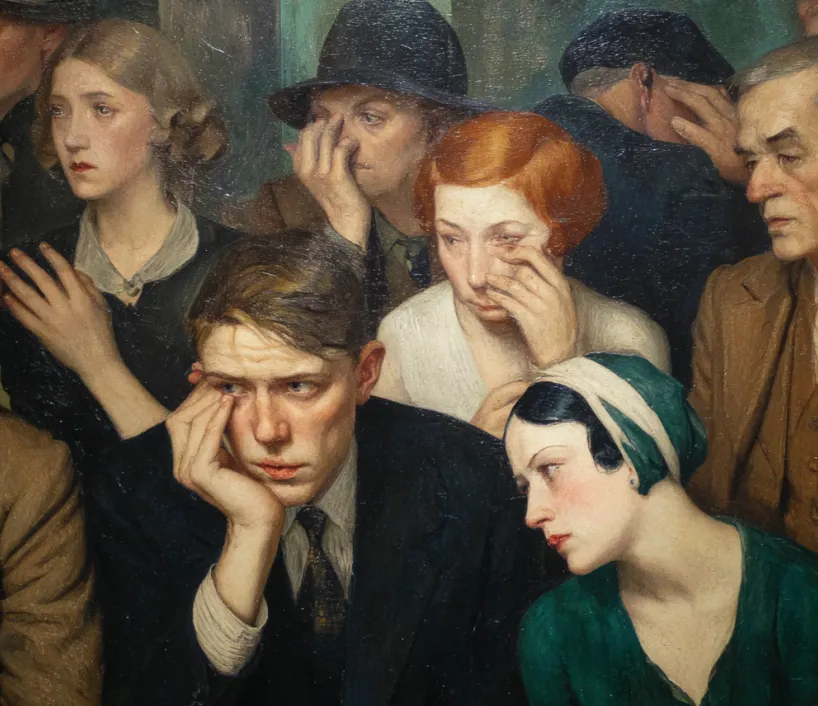
When did you last believe that the world was genuinely getting better? Not incrementally, technologically, or in some narrow measurable way—but morally better? That human beings were progressing toward something better? The question seems silly, doesn’t it? It’s because almost nobody believes this anymore. What’s crazy is, in the past most of us did.
In a 1750 Sorbonne lecture, French economist, Anne Robert Jacques Turgot described history’s march toward perfection.
Thanks for reading! Subscribe for free to receive new posts and support my work.
The human race, viewed from its earliest beginning, presents itself to the eye of the philosopher as a vast whole which, like every individual being, has its time of childhood and progress. . .Manners become gentler; the mind becomes more enlightened; nations, hitherto living in isolation, draw nearer to one another; trade and political relations link up the various quarters of the globe; and the whole body of mankind, through the vicissitudes of calm and tempest, of fair days and foul, continues its onward march, albeit with tardy steps, toward an ever-nearing perfection.[1]
Perfection. This is exactly what people believed was possible. They really believed we were on our way towards perfection—until the 1850s, when it all began to fall apart. Philosophy used to provide meaning for people. And, in Europe, it really did. In prior centuries Europe had a really difficult time with religion, as their rulers, claiming that God chose them to rule, had for centuries exploited their populations and dictated what religions their subjects had to believe. The Enlightenment and the French Revolution to a large extent brought an end to this religious tyranny. And, as belief in religion waned, Europeans turned to philosophy.
It is hard for us moderns to believe, but philosophy used to be important to people. People used to get excited about philosophical systems. In post-French Revolutionary Europe, people looked to philosophy to guide ethical behavior, reform oppressive systems and give life meaning. It was a secular roadmap for moral and social progress.
As the centuries passed, philosophy also lost its grip on people. Since then, much of philosophy has devolved into pedantry. It wastes its energy arguing about trivial points in difficult, indecipherable language. It has fallen by the wayside, and few people pay attention to it anymore.
Meanwhile in the United States, religion continued to provide meaning for many Americans, and Americans have continued to be much more religious than Europeans. But American religiosity has been in decline for decades.
Today many of us, even the religious, instead believe in facts more than theology or philosophical systems. The world has been stripped of the supernatural and even the great ideals. Instead, we have dropped our idealism and become pragmatic. Only those things we can perceive are real. And that is all there is to it. But facts don’t have any profundity. There is no grand meaning behind them. It used to be we believed in human ideals and strove to perfect ourselves and society. Now we shrug, muttering, “It is what it is.”
We have lost belief in human moral progress and replaced it with the idea of social decline. Today, we see the world very differently than Turgot did in 1750. Now we believe that as nations evolve, they grow, mature and finally collapse. The line goes like this: They often start out vigorous, warlike and unsophisticated. They conquer nations around them and establish national boundaries. Then, as generations pass, these nations become wealthy. Their warlike spirit dissipates and wealth and culture grow instead. When these nations become wealthy enough, many no longer have to work, and they acquire the luxury to think for themselves. With wealth comes decadence and the degradation of the original shared national schema, and with that comes factionalism and national decline.
Oswald Spengler popularized this theory in The Decline of the West, which was published in 1918. He wrote that Western Civilization as a whole was entering an age of skepticism, the last stage of civilization, and that there was no way out of it. What would follow would be the end of Western civilization.
Spengler believed that history was cyclical, all civilizations rose and fell, but overall, the human history was enveloped in chaos. He believed that there is no purpose in these cycles of civilizations.
‘Mankind’. . .has no aim, no idea, no plan, any more than the family of butterflies or orchids.[2]
This grim vision took hold after World War I, and it has never really let go.
Before World War I, the Americans were in the Progressive Era. We were fixing everything: prisons, food safety, labor conditions, massive corporations, etc. People believed that they could push American forward, that they could make America better.
But the war killed American idealism. Americans eagerly volunteered to fight “The War to End All Wars,” believing that President Wilson’s League of Nations would end pointless European wars and usher in an era of world peace. We still believed in progress then. Unfortunately, the war delivered on few of Wilson’s promises. Instead, millions were murdered and mutilated in World War I for nothing.
We had so much faith in science ushering in a new age of progress, until the war taught us that science only brought us more effective ways to kill people.
Wilson’s idealistic visions were hijacked by our vengeful European allies. The loss of American lives and fortune was all for nothing, and it was this war that killed the American belief in progress for at least a century.
What would it be like to have an entire society believe in human progress? We cannot know. But if you think about the literature and philosophy of the twentieth century objectively, perhaps then you can see it.
The twentieth century, that is, post-World War I, was a century of pessimism. Art no longer tried to express timeless truths or beauty, but the fleeting emptiness of existence. Twentieth century literature was full of stories of powerless men being mere cogs in a great machine, living frivolous, insignificant lives, where nothing mattered. Existentialism preached the meaninglessness of life. As there is no afterlife, we all die in the end, and that’s it. And as there is no ultimate meaning in life, you have the freedom to create your own trivial meaning, so just come up with a hobby and let that fulfill you. That is hardly hopeful. The twentieth century was a time of despair. And this despair has spilled into the twenty-first century. And that’s where we are today.
So, when you look at the stream of time, you can see, we went from a belief in God, in purpose and meaning, to a belief in philosophical ideals, and finally to where we are now, a belief in mere facts. To many of us, God is dead. To nearly all of us, idealism is dead.
We live in a time of despair, and don’t even know it.
[1] Turgot, “The Successive Advances of the Human Mind,” lecture, Sorbonne Université, December 11, 1750, found in Will and Ariel Durant, The Age of Voltaire, 775.
[2] Oswald Spengler, The Decline of the West, vol. 1 (Alfred A. Knopf, 1926), 21.