
Swedenborg: The Source of Emerson and Jung’s Insights?
The Roots of the Over-soul and Collective Unconscious
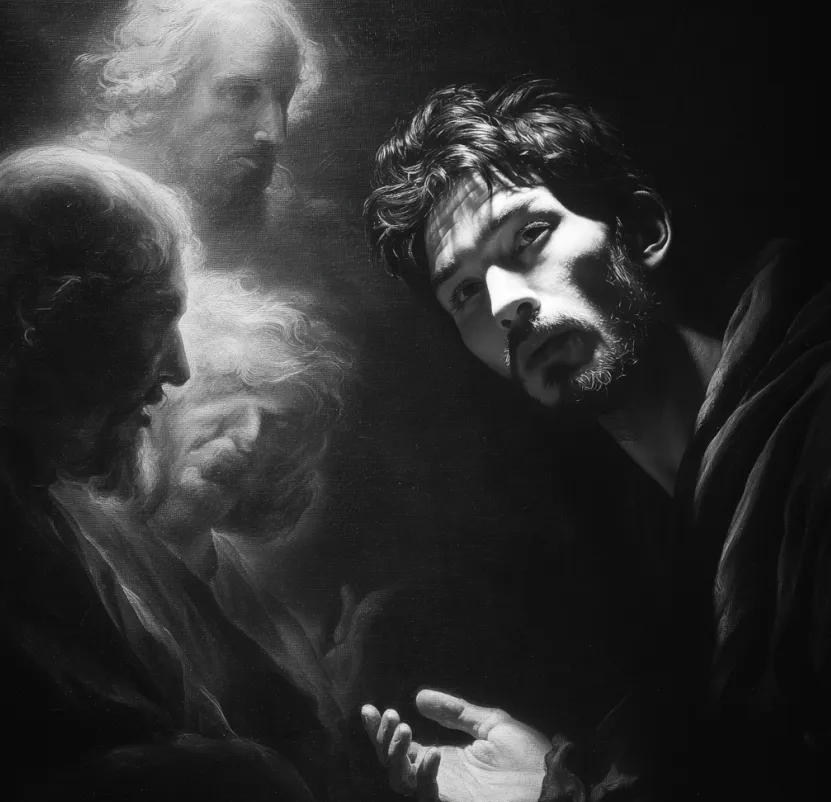
99.999% of us humans can never know the Truth. But some of us can have glimpses. Jung had glimpses. But Emanuel Swedenborg was a true exception. He was the 0.001%. He had unflinching vision. He was able to pass into the spiritual world and directly learn from the entities that are out there. I know, seems unbelievable, but read on.
It is also reassuring that these concepts of a collective soul (i.e. collective unconscious, Over-soul, Soul of the world) were not invented by some lunatics. People have been thinking these concepts for thousands of years in very diverse places. I did not mention that besides Varro, Emerson and Jung, these concepts are found in the Indian holy writings, the Vedas, which feature the world-animating spirit, Brahma. Plotinus, the third century founder of Neoplatonism, wrote of the Universal Soul. He wrote of mystical union with the One. The Roman emperor Julian (the Apostate) was deeply influenced by Neoplatonism. Teilhard de Chardin, a twentieth century priest and archeologist, also wrote on this topic, but he used the term the Noosphere. These ideas of the unity of all minds, souls or whatever you call them have been around in various forms for centuries.
Swedenborg’s Influence
Perhaps the main reason that Emerson and Jung came up with these similar concepts of Over-soul/Collective Unconscious is that they were both familiar with the writings of Emmanuel Swedenborg who lived about 100 years before Emerson and about 190 years before Jung. Both Emerson and Jung revered Emmanuel Swedenborg.[1] They didn’t use his terminology, but my guess is that Swedenborg’s ideas greatly influenced their work.
In his Harvard address of 1836, Emerson praised Swedenborg.
There is one man of genius who has done much for this philosophy of life, whose literary value has never yet been rightly estimated. I mean Emanual Swedenborg. . .he saw and showed the connection between nature and the affections of the soul.
Scholars have differed on the effect of Swedenborg on Emerson’s thought, but Clarence Hotson declared “Swedenborg had more influence on Ralph Waldo Emerson, directly and indirectly, than any other author.”[2]
Remember Emerson writing about how the soul is a receptacle of heavenly influence? Here is Swedenborg on this topic.
All things inflow with man, so that man is only a recipient organ. . .As the eye is a recipient of light, the ears recipients of sound. . .so the understanding is a recipient of the light of heaven or of wisdom, and the will is a recipient of the heat of heaven, thus of love. There is nothing in man but the faculty of receiving.[3]
Swedenborg was a respected eighteenth-century Swedish inventor, scientist and philosopher. He resembled Benjamin Franklin in that he investigated and published books on a variety of subjects, enlarging human knowledge in science. He was offered the chair of mathematics at the University of Uppsala; but he turned it down, since his best work at the time was in geometry, chemistry, and metallurgy. In some of his work, he anticipated the existence of neurons, the existence of the endocrine system, the function of the pituitary gland and the organization of the nervous system—discoveries that would be made much later. He became internationally known for his writings on the smelting of copper and iron. He also wrote philosophy books, trying to integrate philosophy with natural science. Up until a transformative experience, Swedenborg was merely a successful scientist who furthered human knowledge.
In 1745, at age fifty-seven, he went through a six-month period of intense dreams. He kept a dream journal and worked at interpreting his dreams much like Carl Jung did almost 200 years later.
During this period of intense dreams, which biographers consider a religious crisis, he underwent a transformation of character. He recognized and abandoned earlier personality traits of egotism, ambition, selfish pride, scientific vanity and lust. He was amazed how his arrogance had left him, along with a loss of sexual desire. He was becoming saintly.
It is said that his transformation became complete one night when he was dining in a private room in a tavern. The room darkened and the feeling in the room shifted. A man appeared who warned him not to eat too much. This frightened Swedenborg, who hurried home. He was awakened in his sleep by a dream of this same man. This time the man told him that he was the Lord, and that he would reveal spiritual truths to Swedenborg and that he would guide him in what to write. Following this, he was able to converse directly with spirits, which he continued to do nightly for the next twenty-seven years. He wrote over forty volumes describing what he learned, some of which were published and many of which were left in manuscript form at his death.
Explaining his new vocation, he wrote:
It has been granted me, now for several years, to be constantly and uninterruptedly in company with spirits and angels, hearing them converse with each other, and conversing with them. Hence it has been permitted me to hear and see things in another life which are astonishing, and which have never before come to the knowledge of any man, nor entered into his imagination. I have there been instructed concerning different kinds of spirits, and the state of souls after death—concerning hell. . .concerning heaven. . .and particularly concerning the doctrine of faith. [4]
Swedenborg’s claims may appear unbelievable on the surface. At first glance, he may seem to be just another charlatan in a long line of religious conmen. But what was his motive? Swedenborg did not intend to start a church. He had a speech deficiency and could not lecture to crowds. He had no desire for power, notoriety or wealth. He just wrote what he learned in his nightly mystic states.
Think about it.
The Lord created us to be capable of communicating with spirits and angels while still living in our bodies, as people actually did in the earliest times. After all, we are one with spirits and angels. In fact we ourselves are spirits clothed in flesh.[5]
Angels and spirits are merely the souls of people who have already lived and died. They are everywhere around us, much like the flies pestering me as I write this.
Swedenborg and Christianity
Swedenborg was fundamentally a Christian, and all of his beliefs are based on the Bible. Except, he would not accept the Epistles of Paul nor the Acts of the Apostles as legitimate. He also did not approve of many books of the Old Testament.
He diverged from mainstream Christian thought in the following ways: He did not believe in a Trinity. He denied that angels and demons were different beings than humans. They were just the spirits of humans that had already died. He denied predestination. He denied that Christ intervened to take away our sins. He denied justification of faith, which means he believed you cannot get to heaven by merely confessing your belief on your deathbed. He believed we have free will and the final judgement whether we ultimately end up in heaven or hell is a decision we make for ourselves.
He must have been convincing, as a number of well-regarded writers have been influenced by Swedenborg. These include such famous names as: Balzac, Baudelaire, William Blake, Jorge Luis Borges, Elizabeth and Robert Browning, Carlisle, Coleridge, Dostoyevsky, Arthur Conan Doyle, Emerson, Hegel, Goethe, William James, Jung, Kant, Robert Frost, Schelling, Schopenhauer, D.T. Suzuki, Tennyson, Whitman and Yeats. Other notable people influenced by Swedenborg include Helen Keller, Johnny “Appleseed” Chapman and Franklin Delano Roosevelt.
Consciousness Beyond the Physical
Jung and Swedenborg had a lot of ideas in common. Both believed that consciousness extends beyond the physical body. Swedenborg wrote that consciousness does not reside in the organs of the physical body. Instead, all consciousness and meaning reside in the psychic-body (which Jung would call the Collective Unconscious). Jung wrote that any potential thought or feeling we could have is already contained in the Collective Unconscious. We merely need to access it. Jung explicitly designated the Collective Unconscious as infinite and divine. [6]
Jung admitted that he had only an obscure and unclear idea of the Collective Unconscious. It could not be directly observed in ordinary consciousness. He used indirect methods such as spontaneous word associations, active imagination, and the analysis of dreams and religious symbols. His methods worked and formed the basis of Jungian analysis practiced today.
Swedenborg, on the other hand, had obtained passage into this Collective Unconscious. Every night for twenty-seven years, Swedenborg would enter the Collective Unconscious, where he would communicate with spirits of people who had already died. He spoke with people he had known while they were living. He spoke to long-dead authors whose books he had read. Jung had communicated with the dead as well, but I don’t think he got the extensive schooling that Swedenborg got.[7]
Swedenborg was directly conscious of what Jung called the Collective Unconscious. whereas Jung could only dimly perceive it.[8]
Jung dimly realized that the psychic world of the Collective Unconscious is the immortal world of the afterlife into which every human being enters upon death. Jung held that the Collective Unconscious is where all of humanity is congregated, unconsciously to us while we are on earth, but consciously in the afterlife.[9]
In the final essay in this series, we will look at a current day thinker who has integrated these concepts with science.
[1] In 1850, Emerson published an essay on Swedenborg as part of his seven-lecture collection, entitled Representative Men. The other subjects of his writings were Plato, Montaigne, Shakespeare, Napoleon and Goethe. Jung is quoted praising Swedenborg in his autobiography, Memories, Dreams, Reflections. “I admire Swedenborg as a great scientist and a great mystic at the same time. His life and work has always been of great interest to me and I read about seven fat volumes of his writings when I was a medical student.”
[2] Zuber, Devin, “The Sage and His Mystic: Ralph Waldo Emerson and Emanuel Swedenborg,” Accessed on January 1, 2025 at newchurchhistory.org/articles/dz2002.php.
[3] Emanuel Swedenborg, “Conversations with Angels,” Collected Minor Works, (Swedenborg Foundation), swedenborg.com/wp-content/uploads/2013/03/swedenborg_foundation_minor_works.pdf.
[4] George Trobridge, Swedenborg, Life and Teaching (Swedenborg Foundation, 1955), 83–84.
[5] Emanuel Swedenborg, Secrets of Heaven (Swedenborg Foundation, 2008), paragraph 69.
[6] Leon James, “A Comparison of Keywords in the Dynamic Psychology of Jung, Swedenborg and Freud,” Journal of Psychology and Clinical Psychiatry, vol. 3, issue 3, August 8, 2015, medcraveonline.com/JPCPY/a-comparison-of-keywords-in-the-dynamic-psychology-of-jung-swedenborg-and-freud.html
[7] James.
[8] James.
[9] James.