
About the Book
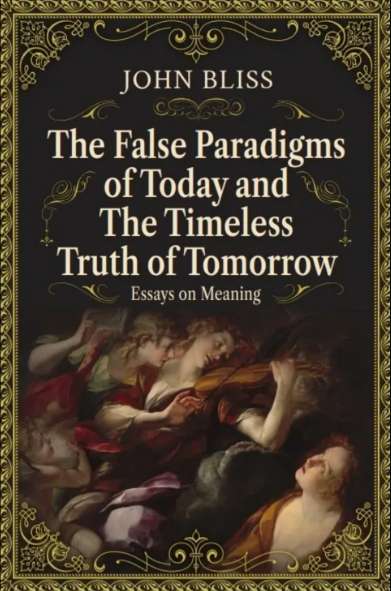
In an age overwhelmed by fleeting trends, collapsing narratives, and comforting half-truths, The False Paradigms of Today and The Timeless Truth of Tomorrow: Essays on Meaning by John Bliss invites readers on a profound journey to strip away illusions and rediscover enduring wisdom.
This collection of 13 incisive essays challenges the fabricated structures shaping modern thought—urging us to question deeply embedded assumptions about science, morality, progress, psychology, and the nature of the self.
Part I: Dismantling Illusions
Bliss reveals that our understanding of the world is far more engineered than we believe.
From society’s obsession with technological progress and the rise of science as a pseudo-religion to the myth of neutrality and rational certainty, he exposes how collective delusions distort our reality.
He examines:
the human longing for immortality,
how modern psychology reshaped morality,
and how evolutionary pressures still govern our behavior beneath the surface.
These essays illuminate the unseen forces that quietly steer society toward conformity, anxiety, and false meaning.
Part II: Reconstructing Deeper Truths
Shifting from critique to reconstruction, Bliss explores timeless ideas across history, myth, and philosophy.
He delves into reason’s limits, the seductive power of utopian thinking, dialogues with the dead, and the dangers of idealism turned tyrannical.
Most importantly, he challenges the modern obsession with self-identity—proposing that letting go of the “false self” is humanity’s next evolutionary step.
This section is a call to rediscover wisdom, uncertainty, humility, and the deeper truths that civilizations repeatedly forget.

A Book for Thinkers, Seekers, and Skeptics
Written with precision and fearless honesty, Bliss blends sociology, mysticism, history, and philosophy into essays that provoke, unsettle, and illuminate.
Ideal for:
-
readers disillusioned by mainstream narratives,
-
followers of philosophy and psychology,
-
and anyone hungry for a more authentic way of understanding reality.
This book is an invitation to awaken from intellectual autopilot—and to discover why long-buried truths still hold the power to liberate us.
Reviews
You cannot just power through this book. There are 13 essays. You read one and then think about it for a day or two, and then read another. I learned that after trying to read several essays at once.
I only had a little trouble with the first science essay. For some reason it was just harder for me to comprehend.
All in all I enjoyed the book. I think if someone has a deep Christian faith. They might not like how the author presents some falsehoods in the Bible.
He tied it all together pretty good at the end. A lot of the concepts and characters he introduced in earlier essays came together in the last one."
The False Paradigms of Today and the Timeless Truth of Tomorrow starts with the premise that Western civilization has successfully replaced spiritual wisdom with corrosive groupthink and bankrupt rationalism, and that we need to recover the understanding of our shared destiny. John Bliss puts together his arguments like a jigsaw puzzle, providing an eclectic body of references, from Hegel and Toynbee on the philosophy of history to Kaczynski and Kierkegaard on the limits of reason, to Schopenhauer on the will, and psychologists from Jung to Maslow. Basing his claims on historical episodes from the Roman Empire to the Enron scandal, he uses mystics such as Ramakrishna, Krishnamurti, and Swedenborg to illuminate his thoughts. This is a powerful book that will appeal to thinkers, philosophy students, and those seeking to understand how truth works. It is written in a conversational, accessible tone that makes it even more engaging and enjoyable. This author confronts the nihilism of our age with something even bolder: a vision of spiritual evolution and collective consciousness that provides a roadmap for meaning.
Part 1 does the heavy lifting of dismantling the ideas most of us have absorbed without questioning: faith in progress, trust in science as a complete picture of reality, the comfort of group identity. Bliss isn't hostile about it, but he's not gentle either. What surprised me was how little I could argue back. Part 2 is where the book really opened up for me. The historical storytelling is genuinely fascinating, pulling from figures and moments I had never encountered before, and weaving them into something that feels cohesive rather than scattered. The sections on Jung's collective unconscious and the shared thread running through mystical traditions across cultures stuck with me long after I finished.
This is not a book that wraps things up neatly, and that's the point. Bliss is more interested in changing how you ask questions than in handing you answers. If you go in expecting a self-help payoff, you'll be frustrated. If you go in willing to sit with uncertainty and let the ideas breathe, you'll find it genuinely rewarding.
What I appreciated most is the seriousness with which the author engages big questions—how modern paradigms shape our thinking, where they may fall short, and what timeless perspectives might still matter. While my own framework and conclusions differ from some of Bliss’s interpretations, I found that difference to be a strength rather than a weakness. At several points, I wanted to pause and discuss his ideas, not to dismiss them, but to explore them more deeply. The book doesn’t shut down conversation; it opens it.
I would recommend this book to readers who enjoy wrestling with ideas, questioning assumptions, and reflecting on long arcs of human thought. Even when you don’t fully agree, the journey itself is worthwhile. This is a book that invites engagement, contemplation, and dialogue—and that, to me, is a sign of meaningful work.